Equations and curves
Equations and curves[edit]
In analytic geometry, any equation involving the coordinates specifies a subset of the plane, namely the solution set for the equation, or locus. For example, the equation y = x corresponds to the set of all the points on the plane whose x-coordinate and y-coordinate are equal. These points form a line, and y = x is said to be the equation for this line. In general, linear equations involving x and y specify lines, quadratic equations specify conic sections, and more complicated equations describe more complicated figures.[17]
Usually, a single equation corresponds to a curve on the plane. This is not always the case: the trivial equation x = x specifies the entire plane, and the equation x2 + y2 = 0 specifies only the single point (0, 0). In three dimensions, a single equation usually gives a surface, and a curve must be specified as the intersection of two surfaces (see below), or as a system of parametric equations.[18] The equation x2 + y2 = r2 is the equation for any circle centered at the origin (0, 0) with a radius of r.
Lines and planes[edit]
Lines in a Cartesian plane, or more generally, in affine coordinates, can be described algebraically by linear equations. In two dimensions, the equation for non-vertical lines is often given in the slope-intercept form:

- m is the slope or gradient of the line.
- b is the y-intercept of the line.
- x is the independent variable of the function y = f(x).
In a manner analogous to the way lines in a two-dimensional space are described using a point-slope form for their equations, planes in a three dimensional space have a natural description using a point in the plane and a vector orthogonal to it (the normal vector) to indicate its "inclination".
Specifically, let be the position vector of some point , and let be a nonzero vector. The plane determined by this point and vector consists of those points , with position vector , such that the vector drawn from to is perpendicular to . Recalling that two vectors are perpendicular if and only if their dot product is zero, it follows that the desired plane can be described as the set of all points such that








In three dimensions, lines can not be described by a single linear equation, so they are frequently described by parametric equations:


- x, y, and z are all functions of the independent variable t which ranges over the real numbers.
- (x0, y0, z0) is any point on the line.
- a, b, and c are related to the slope of the line, such that the vector (a, b, c) is parallel to the line.
Conic sections[edit]
In the Cartesian coordinate system, the graph of a quadratic equation in two variables is always a conic section – though it may be degenerate, and all conic sections arise in this way. The equation will be of the form


The conic sections described by this equation can be classified using the discriminant[20]

- if , the equation represents an ellipse;
- if and , the equation represents a circle, which is a special case of an ellipse;
- if , the equation represents a parabola;
- if , the equation represents a hyperbola;
- if we also have , the equation represents a rectangular hyperbola.






Quadric surfaces[edit]
A quadric, or quadric surface, is a 2-dimensional surface in 3-dimensional space defined as the locus of zeros of a quadratic polynomial. In coordinates x1, x2,x3, the general quadric is defined by the algebraic equation[21]
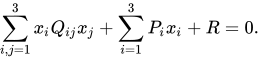
Quadric surfaces include ellipsoids (including the sphere), paraboloids, hyperboloids, cylinders, cones, and planes.
Distance and angle[edit]

In analytic geometry, geometric notions such as distance and angle measure are defined using formulas. These definitions are designed to be consistent with the underlying Euclidean geometry. For example, using Cartesian coordinates on the plane, the distance between two points (x1, y1) and (x2, y2) is defined by the formula


In three dimensions, distance is given by the generalization of the Pythagorean theorem:


Transformations[edit]

Transformations are applied to a parent function to turn it into a new function with similar characteristics.
The graph of is changed by standard transformations as follows:

- Changing to moves the graph to the right units.
- Changing to moves the graph up units.
- Changing to stretches the graph horizontally by a factor of . (think of the as being dilated)
- Changing to stretches the graph vertically.
- Changing to and changing to rotates the graph by an angle .





There are other standard transformation not typically studied in elementary analytic geometry because the transformations change the shape of objects in ways not usually considered. Skewing is an example of a transformation not usually considered. For more information, consult the Wikipedia article on affine transformations.
For example, the parent function has a horizontal and a vertical asymptote, and occupies the first and third quadrant, and all of its transformed forms have one horizontal and vertical asymptote, and occupies either the 1st and 3rd or 2nd and 4th quadrant. In general, if , then it can be transformed into . In the new transformed function, is the factor that vertically stretches the function if it is greater than 1 or vertically compresses the function if it is less than 1, and for negative values, the function is reflected in the -axis. The value compresses the graph of the function horizontally if greater than 1 and stretches the function horizontally if less than 1, and like , reflects the function in the -axis when it is negative. The and values introduce translations, , vertical, and horizontal. Positive and values mean the function is translated to the positive end of its axis and negative meaning translation towards the negative end.




Transformations can be applied to any geometric equation whether or not the equation represents a function. Transformations can be considered as individual transactions or in combinations.
Suppose that is a relation in the plane. For example,



Comments
Post a Comment